
Last Updated: October 25, 2026
Quick Summary
Seasonal cash flow fluctuations occur when a business experiences predictable periods of high revenue followed by slower months, creating timing gaps between when cash is needed and when it arrives. Managing these fluctuations requires building a 12-month forecast, setting aside reserves during peak season, accelerating collections before slow months, and securing working capital to bridge any remaining gaps.
- Build a seasonal cash flow forecast using two years of actual bank statements, collection timing, and expense patterns to identify cash gaps 90 days in advance.
- Calculate your target reserve by multiplying monthly slow-season expenses by the number of slow months and move that amount to a separate account during peak season.
- Accelerate collections before slow months by invoicing immediately, offering early-payment discounts, requiring deposits on large orders, and calling every account over 60 days past due.
- Set automatic spending cuts in order of reversibility: discretionary expenses first, then marketing, inventory, hiring, and fixed commitments last.
- Secure a line of credit or seasonal loan before you need it desperately, sized to your forecasted shortfall and repaid during peak season.
Table of Contents
- Understanding Seasonal Cash Flow Fluctuations
- Build a Seasonal Cash Flow Forecast
- How to Prepare for Slow Season in Business
- Managing Cash Flow During Slow Months
- Secure Working Capital for Seasonal Businesses
- Track Cash Position and Set Warning Thresholds
- Get a Free Cash Flow Analysis
- Frequently Asked Questions
Understanding Seasonal Cash Flow Fluctuations
The problem isn’t that these patterns exist, it’s that most owners don’t plan for them.
At Alexander Financial Solutions, we understand that seasonal fluctuations are predictable, not surprises.
For seasonal businesses, the challenge isn’t a lack of revenue, it’s that timing doesn’t match expenses.
The good news: this is entirely manageable. You don’t need to reinvent your business model. You need a plan.
Build a Seasonal Cash Flow Forecast
A seasonal cash flow forecast projects cash in and out month by month for the next 12 months. The goal isn’t perfect revenue prediction, but seeing the timing gap between spending and collecting so you can act before it arrives.
Most forecasts fail because they track revenue instead of cash receipts. A $60,000 sale in November that the customer pays in February does nothing for November payroll. Build on expected collection dates, not invoice dates.
Step 1: Gather two years of actuals
Pull bank statements, P&Ls, AR aging, and sales records for the last 24 months. Look for three patterns:
- Revenue seasonality. Which months are consistently above and below your annual average?
- Collection timing. What percentage of invoices are paid in 0-30 days, 31-60 days, and 61+ days? A common pattern is that peak-season customers pay slower because your team is busy fulfilling orders and stops chasing invoices.
- Expense timing. Payroll is steady, but inventory purchases, insurance renewals, estimated tax payments, and debt payments cluster in specific months.
Step 2: Build the month-by-month model
Use a spreadsheet with one column per month and these rows. The formulas are simple; the discipline is in the assumptions.
| Row | What to enter | Formula or source |
|---|---|---|
| Beginning cash | Prior month’s ending cash | Prior row |
| Cash collected from sales | Revenue × collection percentage by lag | Historical aging data |
| Other cash in | Loan draws, asset sales, deposits | Known commitments |
| Payroll and owner draws | Fixed headcount × rate | Payroll register |
| Rent and occupancy | Lease amount | Lease |
| Inventory and materials | Cost of goods sold × seasonal factor | Purchase history |
| Debt service | Principal + interest | Loan statements |
| Taxes | Estimated payments | Prior-year liability |
| Other operating expenses | Insurance, utilities, software | Vendor contracts |
| Total cash out | Sum of expense rows | Formula |
| Net cash flow | Cash in minus cash out | Formula |
| Ending cash | Beginning cash + net cash flow | Formula |
| Minimum cash reserve | Target buffer | Policy decision |
| Surplus or shortfall | Ending cash minus minimum reserve | Formula |
The last two rows are the ones most forecasts omit. They convert a cash balance into a decision: you either have surplus to set aside or a shortfall to fund.
Step 3: State your assumptions explicitly
A forecast is only as good as its assumptions. Write them in a separate tab so you can test them later. Typical assumptions include:
- Percentage of sales collected in the same month, 30 days later, and 60 days later.
- Expected revenue growth or decline versus the same month last year.
- Wage increases and new hires by month.
Label every assumption cell in a different color from calculated cells. When actuals arrive, you update only the colored cells and the forecast recalculates. This turns a one-time exercise into a monthly routine.
Step 4: Model best case, base case, and worst case
One forecast is a guess. Three scenarios are a plan. Build three versions of the same sheet:
- Base case. Your most likely revenue and collection timing based on the last two years.
- Best case. Revenue 10-15% above base and collections 10 days faster. Use this to plan how much you can set aside for reserves.
- Worst case. Revenue 15-20% below base, collections 15-30 days slower, and one major customer paying late. Use this to size your credit line and reserve target.
Fund your reserve and credit line to the worst-case shortfall, not the base case. The base case is what you expect. The worst case is what you survive.
Step 5: Roll it forward monthly
Each month, replace the forecast with actuals and re-forecast the remaining 11 months. After three or four cycles, your assumptions will be close enough that the forecast becomes a reliable early-warning system.
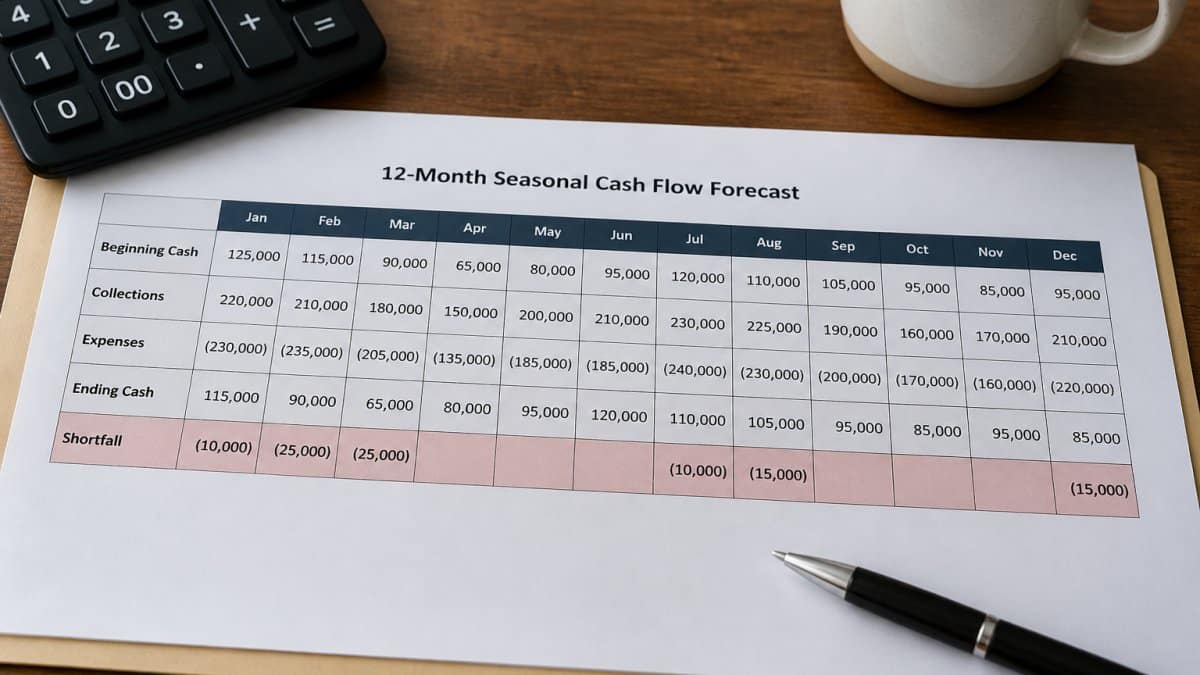
The forecast earns its keep in the shortfall row. If you can see the month and the dollar amount of your gap 90 days before it arrives, you have time to collect receivables, delay purchases, or draw on a line of credit on your terms rather than the lender’s.
How to Prepare for Slow Season in Business
Preparing for slow season starts during peak season, where most owners miss the opportunity.
When revenue is strong, the instinct is to spend on office upgrades, equipment, and extra staff.
Instead, treat peak season as your savings window.
If your slowest quarter needs $50,000 per month for three months, you need $150,000 set aside. Move it to a separate account during peak season and don’t touch it except for slow-season expenses.
Common mistakes to avoid:
- Hiring too much staff during peak season. Seasonal staff is fine. Permanent hires you can’t afford in slow months create problems.
- Committing to fixed expenses you can’t scale down. Long-term leases and service contracts lock in costs when you need flexibility.
- Delaying collections. During peak season, get paid faster. Don’t let customers stretch payment terms.
The strategic move: negotiate flexible terms with vendors during peak season. Ask to reduce orders during slow months, many suppliers appreciate predictable customers and will work with you.
Managing Cash Flow During Slow Months
Managing cash flow during slow months is mostly about timing, not cutting. You can’t renegotiate rent overnight, but you can change when cash leaves and arrives. The levers fall into four groups: collections, payment terms, spending, and triggers.
Accelerate collections before the slow months start
The cheapest cash you’ll ever access is money customers already owe you. Discover how improving cash flow with receivables factoring can convert outstanding invoices into immediate cash during slow months. Work the receivables aging report weekly, starting 60 days before slow season.
- Invoice immediately. Send invoices the day goods ship or services are delivered. A three-day delay in invoicing is a three-day delay in cash.
- Make paying easy. Offer ACH, card, and an online payment link. Card and ACH payment options can shorten collection time, even after card processing fees.
- Segment the aging report. Call every account over 60 days personally. Send written reminders at 30 and 45 days. Do not wait for 90 days to escalate.
Reset payment terms on both sides of the ledger
Payment terms are a negotiation, not a fixed industry feature. Review them before slow season.
With customers: Shorten net-60 terms to net-30 where competitive conditions allow. Add late fees where your contracts permit. For repeat customers, consider requiring a card on file.
With suppliers: Ask for extended terms during your slow months. Moving from net-30 to net-45 or net-60 on inventory and materials is effectively an interest-free loan.
Do not stretch supplier terms so far that you damage the relationship or lose early-payment discounts that exceed the value of the extra float. Compare the discount rate to your cost of borrowing before you give it up.
Cut spending in the right order
When cash is tight, cut in order of reversibility. Start with spending you can restore quickly and end with commitments that carry penalties. (Source: IRS guidelines on estimated taxes)
- Discretionary and deferrable. Subscriptions, memberships, travel, training, and non-urgent equipment. Cancel or pause.
- Marketing with no near-term return. Shift budget toward retention and collections rather than brand spend.
- Inventory. Reduce purchase orders to match the lower sales velocity. Do not build stock you will finance into the next peak.
- Hiring and contractors. Freeze new permanent hires. Use seasonal or contract labor tied to volume.
- Fixed commitments. Renegotiate leases, service contracts, and insurance only after the easier cuts are exhausted, because these carry penalties and long lead times.
Set triggers, not resolutions
A slow-month plan fails when it depends on willpower. Write thresholds in advance so decisions are automatic.
| Metric | Warning threshold | Action when breached |
|---|---|---|
| Cash balance | Below 1.5 months of fixed costs | Freeze discretionary spend; call top overdue accounts |
| Days sales outstanding | Above 45 days | Escalate collections; pause credit terms for slow payers |
| Days cash on hand | Below 30 days | Draw on line of credit; delay non-critical purchases |
| Inventory turnover | Falling for two consecutive months | Cut reorders; discount slow-moving stock |
| Current ratio | Below 1.2 | Review short-term obligations; talk to lender early |
Update the dashboard weekly during slow months. The point is not the number itself but the pre-agreed action that follows it.
Use financing as a bridge, not a habit
If collections and spending changes still leave a gap, use short-term financing sized to the forecasted shortfall, not the maximum available. A line drawn in the slow month and repaid in the first strong month costs interest for a defined period; one covering operating losses month after month signals the business model, not the calendar, needs attention.
Slow months reward preparation made in strong months. Collections discipline, negotiated terms, and pre-set triggers turn a cash crunch into a manageable, forecasted event.
Secure Working Capital for Seasonal Businesses
When your forecast shows a cash gap savings can’t cover, you need working capital.
Traditional banks look at your lowest revenue month and assume that’s your baseline.
That’s why working capital loans for seasonal businesses exist.
At Alexander Financial Solutions, we look at your full 12-month cycle, not just slow months, and we understand the math.
The key is showing lenders your forecast: provide historical data, demonstrate the pattern, show you’ve prepared.
Working capital options for seasonal businesses include:
- Lines of credit. Borrow what you need, when you need it. Repay during peak season. Pay interest only on what you use.
- Seasonal loans. Fixed amount, timed to your cash gap, repaid when revenue returns.
- Invoice financing. Convert customer invoices into immediate cash.
Timing matters.
Track Cash Position and Set Warning Thresholds
Tracking your cash position means knowing exactly how much cash you have available at any moment.
Many owners confuse profit with cash.
Set up a simple daily cash tracking system. Record:
- Beginning cash balance
- Cash in (sales, loans, customer payments)
- Cash out (payroll, expenses, debt payments)
Do this daily during slow season; weekly is acceptable during peak.
Next, set warning thresholds. What’s the minimum cash balance to stay operational?
When you hit that threshold, specific actions trigger automatically:
- Stop all discretionary spending immediately.
- Contact customers with outstanding invoices and ask for immediate payment.
- Review upcoming expenses and defer anything that can wait.
How to calculate liquidity ratios for your business helps you understand whether your cash position is healthy.
Create a simple dashboard:
| Metric | Target | Current | Status |
|---|---|---|---|
| Cash Balance | $25,000+ | $18,000 | Warning |
| Days Cash on Hand | 30+ | 22 | Warning |
| Current Ratio | 1.5+ | 1.2 | Caution |
| Quick Ratio | 1.0+ | 0.9 | Action Needed |
This takes 10 minutes weekly and keeps you from being surprised.
Get a Free Cash Flow Analysis
Seasonal businesses can struggle when they lack a clear picture of their finances, leading to guessing, hoping, and reacting instead of planning.
This analysis includes:
- A detailed review of your seasonal patterns
- A 12-month cash flow projection based on your actual data
- Identification of your cash gaps and their timing
The goal is to help you understand your cash flow, anticipate what’s coming, develop a plan, and avoid surprises.
Get pre-qualified for working capital that matches your seasonal needs.
Your seasonal business doesn’t have to be a cash flow roller coaster.
Frequently Asked Questions
How do you manage seasonal cash flow fluctuations?
Manage seasonal cash flow fluctuations by forecasting revenue and expenses across a 12-month cycle, building cash reserves during peak seasons, and controlling discretionary spending during slower months. Track your cash position weekly or monthly, set minimum balance thresholds to trigger action, diversify revenue streams where possible, and arrange backup financing (like a line of credit) before you need it. This combination of planning, discipline, and access to capital keeps your business stable year-round.
What is a seasonal cash flow forecast and why do I need one?
A seasonal cash flow forecast is a 12-month projection of your expected cash inflows and outflows, broken down by month. It shows when revenue peaks, when expenses spike, and where gaps appear. You need one because it reveals exactly when you’ll run short of cash, before it happens. This lets you arrange financing, reduce spending, or adjust purchasing in advance instead of scrambling when cash runs dry. Without it, you’re flying blind.
How much cash should a seasonal business keep in reserve?
Reserve enough to cover your fixed costs (payroll, rent, insurance, debt payments) for 2-3 months of your slowest season. For example, if your monthly fixed costs are $20,000 and your slowest three months generate minimal revenue, aim for $40,000-$60,000 in liquid reserves. Build this during your peak season by setting aside a percentage of cash surplus each month. The exact amount depends on your business volatility and risk tolerance.
What financing options can help cover seasonal cash flow gaps?
Options include a line of credit (draw only when needed), invoice factoring (if you’re B2B), seasonal loans, and equipment financing to support growth during peak periods. Each has different terms, costs, and approval timelines. A line of credit is flexible but requires approval upfront. Invoice factoring converts unpaid invoices to cash immediately but costs a percentage of the invoice. Discuss your cash gap size, timing, and business type with a financial professional to find the right fit for your needs.
Seasonal cash flow fluctuations are predictable. That’s your advantage. Businesses that fail treat them as surprises. Businesses that succeed treat them as a planning exercise. We help you be in the second group. Get started with a free analysis from Alexander Financial Solutions, and see exactly how to strengthen your cash position through every season.


