
Table of Contents
- Equipment Lease vs Loan: Tax Implications at a Glance
- How the IRS Views Equipment Financing Agreements
- Capital Lease vs Operating Lease Tax Treatment
- Equipment Depreciation Schedules and IRS Rules
- Section 179 Deduction Limits and Bonus Depreciation
- Tax Benefits of Equipment Loans vs Leases
- Cash Flow Impact: Immediate Tax Savings vs Long-Term Asset Ownership
- Choosing Between Lease and Loan: Key Factors
- Frequently Asked Questions
Last Updated: September 21, 2026
Equipment Lease vs Loan: Tax Implications at a Glance
When deciding between an equipment lease and a loan, tax implications often tip the scales. Understanding how the IRS treats each option is essential for your business. Alexander Financial Solutions helps businesses understand what each option means for their tax liability and cash flow.
The core difference is straightforward: with a lease, you deduct monthly payments as a business expense. With a loan, you own the asset and claim depreciation deductions over time. But that simple distinction masks layers of complexity that directly affect your bottom line.
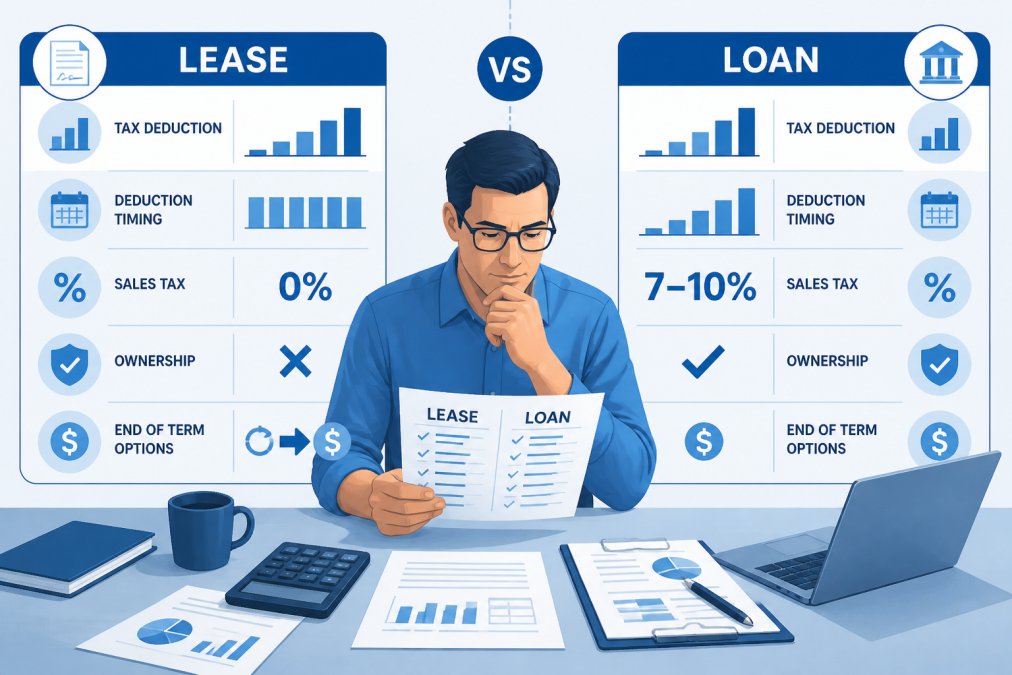
The choice between equipment lease vs loan tax treatment depends on your financial situation, equipment type, and business strategy. A manufacturer with heavy equipment faces different tax math than a consulting firm upgrading computers. The wrong choice can cost thousands in missed deductions or unexpected tax liability.
The IRS classification of your agreement determines everything. Even if you call it a lease, the IRS might classify it as a capital lease, triggering depreciation rules instead of expense deductions. Always verify the actual treatment with your accountant before signing.
How the IRS Views Equipment Financing Agreements
The IRS doesn’t care what you call the arrangement, substance matters. A transaction labeled as a “lease” might be reclassified as a conditional sales contract if it indicates you’re actually purchasing the equipment.
The IRS examines several factors to determine ownership intent. A nominal purchase option (like a $1 buyout), a lease term covering most of the equipment’s useful life, or lease payments equaling most of the fair market value all signal a purchase rather than a lease.
According to IRS guidance on lease classification, the substance-over-form doctrine applies. Your documentation must reflect the actual economic reality of the transaction. This is where many business owners encounter surprises during tax audits.
The equipment lease vs loan distinction becomes critical during IRS audits. Reclassification from operating to capital lease means lost deductions and back taxes plus penalties.
Nominal buyout options ($1 at lease end) are red flags for IRS reclassification. The IRS views these as evidence that you’re purchasing the equipment, not leasing it. This single feature can flip your entire tax treatment from operating expense to depreciation-based deductions.
Capital Lease vs Operating Lease Tax Treatment
These two lease types create fundamentally different tax outcomes. Understanding the distinction is non-negotiable for equipment lease vs loan tax planning.
Operating Leases: Full Deductibility as Business Expense
An operating lease allows you to deduct 100% of monthly lease payments as a business expense in the year you pay them, providing immediate cash flow benefits.
The IRS defines an operating lease as a short-term rental where the lessor retains ownership, maintains the equipment, handles insurance, and bears obsolescence risk. You return it at lease end with no buyout or ownership transfer.
Operating leases work best for equipment that becomes outdated quickly, technology, vehicles, and specialized manufacturing equipment. You avoid obsolete assets while claiming full deductions.
The cash flow benefit is immediate: lease $500 monthly, deduct $500 that month. No depreciation schedules, salvage calculations, or useful-life estimates.
Capital Leases: Depreciation and Interest Deductions
A capital lease is economically a purchase. The IRS treats you as the owner for tax purposes. You claim depreciation deductions and deduct the interest portion of payments separately from principal.
You record capital lease equipment as an asset at fair market value, depreciate it over its useful life, and deduct the interest portion of payments as an expense.
This creates a timing difference: total deductions may exceed operating lease deductions but are spread across years, with lower early deductions due to declining asset value.
Capital leases appear as both asset and liability on your balance sheet, affecting lender-examined ratios. Some businesses prefer operating leases to keep these off-balance-sheet.
Equipment Depreciation Schedules and IRS Rules
Depreciation converts asset ownership into tax deductions. The IRS publishes specific schedules determining deduction speed.
Most business equipment falls into 5-year or 7-year MACRS categories. Manufacturing equipment, computers, and office furniture typically use these schedules; specialized equipment may qualify for 3-year or 15-year schedules.
Under the general depreciation system, most equipment uses 200% declining balance for the first half of useful life, then switches to straight-line. This front-loads deductions.
Straight-line depreciation claims equal deductions yearly but is less favorable from a time-value-of-money perspective.
IRS Publication 946 on How to Depreciate Property provides detailed depreciation tables and rules. The publication is dense, but essential for understanding exactly which schedule applies to your equipment.
Salvage value is irrelevant under MACRS. You can claim full depreciation even if equipment retains significant resale value.
MACRS depreciation typically allows faster deductions than actual economic depreciation. You can deduct the full cost even if the equipment retains 30-40% of its original value. This is why equipment ownership creates valuable tax deductions.
Section 179 Deduction Limits and Bonus Depreciation
Section 179 of the Internal Revenue Code allows immediate expensing of equipment purchases up to an annual limit. This is where equipment lease vs loan tax benefits diverge most dramatically.
Section 179 vs. Bonus Depreciation: Key Differences
Section 179 lets you deduct the full equipment cost in the purchase year, up to the annual limit. It phases out if you purchase above a certain amount and requires taxable income (unless carried back).
Section 179 applies only to purchases, not leases. This is a major tax advantage of purchasing over leasing.
Bonus depreciation allows you to deduct a percentage of new equipment cost in the purchase year, then depreciate the remainder. It applies to new equipment only, not used or leased equipment.
You can elect Section 179 for some equipment and bonus depreciation for others in the same year, optimizing deductions based on your equipment mix and income.
Section 179 has income limitations. If your taxable income is below the deduction amount, you can only deduct up to your taxable income. Excess Section 179 deductions carry forward to future years, but you cannot claim them against prior years unless you file an amended return.
Bonus depreciation has no income limitation. You can claim bonus depreciation even if it creates a loss. This makes bonus depreciation more valuable than Section 179 for some high-income businesses.
Tax Benefits of Equipment Loans vs Leases
The tax advantage of loans versus leases depends entirely on your situation, equipment type, and depreciation eligibility.
Equipment loans create ownership, which unlocks Section 179 and bonus depreciation. If you purchase equipment with a loan, you can immediately deduct the full cost (up to Section 179 limits) or claim bonus depreciation on the remainder. This front-loads your deductions and reduces taxable income in the purchase year.
Operating leases offer consistent, predictable deductions. You deduct the same amount each year. This simplicity appeals to businesses that prefer straightforward tax treatment without depreciation calculations.
Capital leases split benefits between depreciation and interest deductions. Your total tax benefit may exceed an operating lease, but it’s distributed over multiple years. Early years show larger deductions due to depreciation; later years show smaller deductions as the asset depreciates and interest becomes a smaller portion of each payment.
The equipment lease vs loan tax comparison shifts when you factor in interest expenses. Loan payments include both principal and interest. You deduct only the interest portion. Principal payments reduce the asset’s basis but don’t create a separate deduction.
Lease payments are entirely deductible, no distinction between principal and interest. This makes lease payments more tax-efficient on a per-dollar basis, even though the total tax benefit of ownership often exceeds leasing.
Alexander Financial Solutions helps business owners model both scenarios. Our analysis can show how Section 179 deductions, bonus depreciation, and lease expense deductions may affect your specific tax situation.
Cash Flow Impact: Immediate Tax Savings vs Long-Term Asset Ownership
Tax deductions translate to cash savings only when you have taxable income to offset. A business with zero profit gets no benefit from depreciation deductions.
Immediate Section 179 deductions reduce taxable income in the year of purchase. If you’re profitable, this creates immediate tax savings. The cash benefit arrives when you file your tax return and claim the deduction. For businesses with strong cash flow, this is valuable.
Operating lease deductions are also immediate. You deduct payments in the year you pay them. There’s no timing difference between the cash outflow and the tax deduction.
Long-term asset ownership through loans creates depreciation deductions spread across multiple years.
Choosing Between Lease and Loan: Key Factors
The decision between equipment lease vs loan tax treatment requires analyzing multiple factors beyond pure tax implications.
Frequently Asked Questions
What are the main tax differences between an equipment lease and an equipment loan?
With an equipment lease, monthly payments are typically deductible as a business expense if it qualifies as an operating lease. With an equipment loan, you deduct depreciation and interest separately. Operating leases offer immediate full deductibility, while loans allow you to claim depreciation over the equipment’s useful life and interest on the unpaid balance. The choice affects your taxable income, timing of deductions, and balance sheet treatment.
How does Section 179 deduction limits apply to equipment loans versus leases?
Section 179 allows you to deduct the full purchase price of qualifying equipment in the year you buy it, rather than depreciating it over time. This applies to equipment loans where you own the asset. Operating leases do not qualify for Section 179 because you don’t own the equipment. If your business qualifies and you choose to purchase, Section 179 can provide significant immediate tax savings compared to leasing.
Can I deduct lease payments as a business expense?
Yes, if the lease qualifies as an operating lease under IRS guidelines. Monthly lease payments are fully deductible as a business operating expense. However, if the lease is classified as a capital lease, you cannot deduct the full payment; instead, you deduct depreciation and interest separately. The IRS evaluates lease terms to determine classification, including lease duration, purchase options, and residual value.
What happens to equipment depreciation schedules when I purchase versus lease?
When you purchase equipment with a loan, you depreciate the asset over its useful life according to IRS depreciation schedules, typically using Modified Accelerated Cost Recovery System (MACRS). This creates deductions spread across multiple years. With an operating lease, there is no depreciation because you don’t own the asset; instead, lease payments are the deduction. Capital leases follow a hybrid approach where you depreciate the asset as if you owned it.


